

When exploring the directory of tantra retreats, one of the most common questions beginners ask is whether they should attend as a single individual or with a romantic partner. Because tantra is deeply rooted in connection, intimacy, and relational dynamics, both formats offer distinct pathways. However, they serve very different intentions and require different levels of emotional readiness.
Choosing between a singles-focused retreat and a couples-focused retreat is not merely a matter of relationship status. It is about understanding what you want to explore, how you want to interact with others, and what boundaries will make you feel secure. By examining the structural differences, benefits, and challenges of each format, you can select the environment that best supports your personal development.
The Singles Experience: Self-Exploration and Shared Connection
A singles tantra retreat focuses on self-discovery, personal boundaries, and learning authentic communication. It provides a structured space to practice expressing your needs and saying “no” to strangers in a highly controlled, facilitator-led environment.
There is a common misconception that tantra retreats are exclusively for couples. In reality, a significant portion of the tantra community consists of solo attendees. Tantra retreats designed for singles or open to individual participants focus heavily on self- discovery, personal boundaries, and learning how to relate to others from a grounded place.
The Focus of Singles Retreats
In a singles retreat, the primary relationship under exploration is the one you have with yourself. The curriculum is designed to help you connect with your own body, understand your personal desires, and identify your emotional patterns. Before you can relate deeply to another person, you must first have a clear understanding of your own internal landscape.
These retreats provide an exceptional laboratory for practicing communication and boundary setting. Because you are interacting with people you do not know, you are free from the historical patterns and expectations that often exist in established relationships. This clean slate allows you to practice expressing your boundaries cleanly, saying “no” without guilt, and asking for what you want with absolute clarity.
How Partner Work Works for Solo Attendees
A natural concern for singles is how partner exercises are handled. In a reputable singles- friendly retreat, partner matching is structured, consensual, and highly respectful.
During exercises, facilitators will guide participants to form pairs. This is often done through a structured process where you check in with a potential partner to see if there is mutual consent to work together. You are never forced to work with anyone, and you can choose to complete exercises solo if you prefer.
To maintain safety and prevent intense attachments from forming too quickly, facilitators often encourage participants to rotate partners for different exercises. This rotation keeps the focus on the practical application of the tools, such as eye contact, active listening, or light touch, rather than romantic or sexual attraction. It teaches you to connect with human beings as they are, without the pressure of dating or mating dynamics.
The Couples Experience: Deepening Intimacy and Navigating Blocks
A couples tantra retreat is a closed-loop experience designed strictly for romantic partners to rebuild trust, enhance communication, and deepen physical intimacy. All partner exercises are performed exclusively with your partner, with no rotation or interaction with other attendees.For romantic partners, a couples-focused tantra retreat offers a dedicated space to step away from daily responsibilities and focus entirely on their relationship. These retreats are designed to help couples rebuild trust, enhance physical and emotional intimacy, and learn new ways of communicating.
The Focus of Couples Retreats
In a couples retreat, the container is closed. This means that all partner exercises, communication practices, and physical touch occur exclusively between you and your partner. There is no rotation of partners, and there is no requirement to engage in intimate practices with anyone else.
The curriculum typically addresses the common challenges that arise in long-term relationships, such as routine, lack of presence, emotional distance, or mismatched desires. Through guided practices, couples learn to slow down, look at each other with fresh eyes, and cultivate a deeper energetic and physical connection.
Key Differences in Structure and Intention
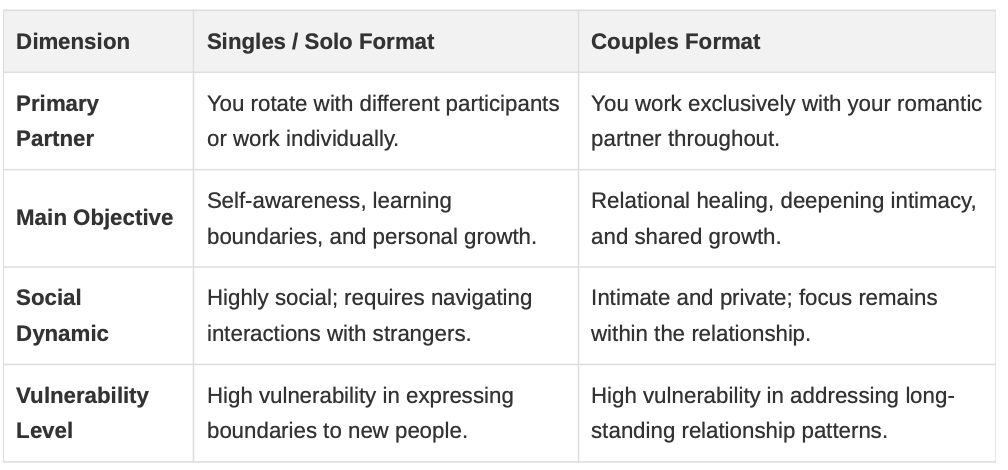
The primary difference lies in the relational container: singles retreats feature open-format interactions with multiple participants to build individual boundary skills, while couples retreats maintain a private, closed loop to focus exclusively on the history and future of the relationship.
To help you decide which path is right for you, it is useful to compare the two formats across several structural dimensions.
Intention and Goals
Singles: Individual empowerment, understanding personal boundaries, healing personal intimacy blocks, and learning authentic communication.
Couples: Rebuilding relational trust, deepening physical and emotional intimacy, resolving communication blocks, and exploring shared energetic connection.
Interaction Dynamics
Singles: High interaction with a variety of participants. Structured partner rotation. Focus on learning to express boundaries with different personality types.
Couples: Closed loop interaction. All exercises are done strictly with your romantic partner. Focus on the specific history and future of your relationship.
Singles vs Couples: What to Consider
How to Choose Based on Your Current Situation
Choose a couples retreat if both partners are mutually interested in deepening intimacy and your relationship is stable. Choose a solo retreat if only one partner is interested, if you have personal trauma to resolve, or if your relationship is in acute crisis and you need individual space.
If you are currently single, the choice is straightforward. A singles or open-format retreat is the perfect place to start. It allows you to focus entirely on your own healing, build your communication skills, and meet a community of like-minded individuals who value safety and self-awareness.
If you are in a relationship, the decision requires a thoughtful conversation with your partner. Here are a few guidelines to help you navigate this choice.
Choose a Couples Retreat If:
- Both you and your partner are genuinely curious about tantra and eager to explore it together.
- You want to dedicate focused, uninterrupted time to deepening your physical and emotional connection.
- Your relationship is stable, and you are looking to enhance your intimacy rather than fix an active, acute crisis.
Consider a Solo Retreat (Even If in a Relationship) If:
- Only one of you is interested in tantra, and the other partner feels pressured or highly uncomfortable with the idea.
- You have personal intimacy blocks, past trauma, or boundary challenges that you need to work through individually before bringing them into your relationship.
- Your relationship is currently experiencing severe conflict, and you need individual space to ground yourself and find clarity.
Ultimately, whether you attend alone or with a partner, the right tantra retreat should feel like a supportive, non-judgmental environment. By being honest about your current needs, boundaries, and relationship dynamics, you can choose a format that allows you to explore connection in a way that feels safe, authentic, and deeply respectful.
Common Questions
Explore Tantra Retreats
Whether you are looking to explore tantra on your own or deepen intimacy with your partner, our directory features curated, beginner-friendly retreats tailored to your needs.